
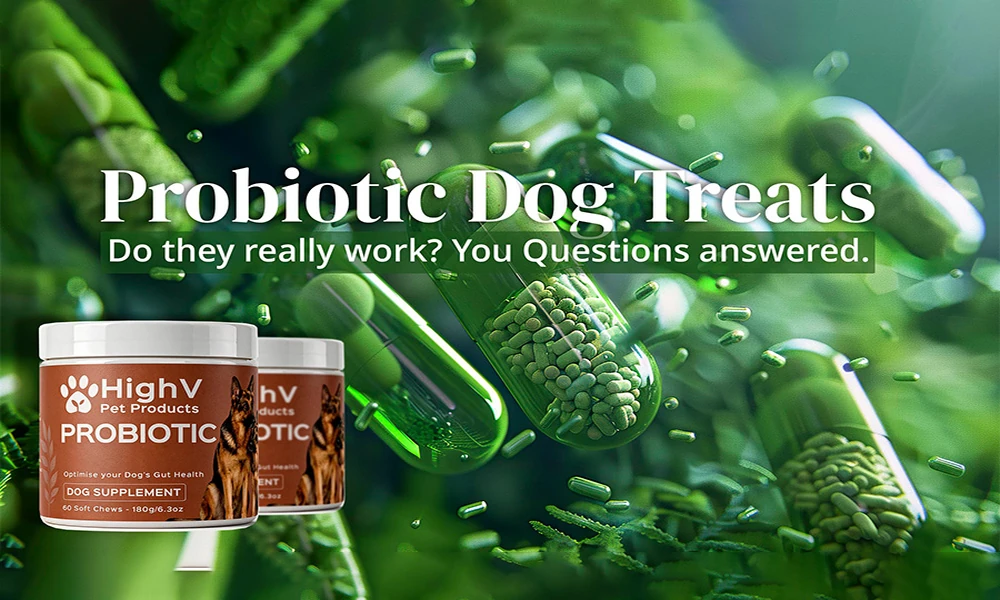
Walk into any UK pet shop, or browse online, and the range of probiotic products for dogs is bewildering. There are powders to sprinkle on food, pastes in syringes, capsules to hide in cheese, liquid drops, soft chews, baked biscuits and complete diets with probiotics already added. They all promise, in carefully worded language, to support your dog’s digestion. For an owner whose dog has a sensitive stomach, the question is not so much whether to feed a probiotic as which format is actually going to work in real life, day after day.
That practical question matters more than it might seem. Probiotics are live organisms, and they only contribute to the gut if they arrive there alive and are fed consistently. A powder that sits unopened in a cupboard because the dog refuses food with anything sprinkled on it, or a capsule that is spat out behind the sofa every evening, is doing nothing. The best format is the one your particular dog will reliably take, that survives storage in your particular home, and that fits your particular routine.
This guide compares the main formats available to UK owners, explains the rules that apply to all of them, and looks in detail at why Probiotic Dog Chews have become one of the most popular options for everyday use. It also covers what to look for on a label, how to store live products and when a digestive problem needs a vet rather than a supplement.
First, the Rules That Apply to Every Format
Whatever the format, a probiotic fed to a dog in the UK is regulated as animal feed. The live microorganisms themselves are feed additives in the gut flora stabiliser category, and only strains that have been assessed and authorised may be used, each with defined minimum inclusion levels. The most common authorised strain in dog products is a particular strain of Enterococcus faecium; authorised Bacillus and Lactobacillus strains also appear. The finished product, whether chew, powder or paste, is a complementary pet food and must follow UK pet food labelling rules, stating its composition, additives, analytical constituents and feeding instructions.
None of these products is a veterinary medicine. The Veterinary Medicines Directorate regulates medicines in the UK, and anything claiming to treat, cure or prevent disease in an animal needs a VMD marketing authorisation. A feed product cannot make those claims, so a responsibly labelled probiotic, in any format, will talk about supporting normal digestive function or helping to maintain a balanced gut flora, and nothing stronger. If a product claims to cure diarrhoea, treat colitis or fix a sensitive stomach, that is a red flag about the manufacturer, not a reason to buy. And no format replaces a vet if your dog is unwell.
Powders
Powders are the traditional format, sold in tubs with a measuring scoop, and they remain popular. Their strengths are flexibility of dosing, which is useful for multi-dog households or very large and very small dogs, and often a high number of live organisms per serving. They are frequently combined with prebiotic fibres. Their weaknesses are practical. Many dogs dislike anything sprinkled on their food and will eat around it or refuse the meal entirely. Powders are exposed to air and moisture every time the tub is opened, which shortens the life of the bacteria, and the scoop tends to be lost within a week. They are also unsuitable for dogs fed a purely dry diet unless the food is moistened, because the powder falls to the bottom of the bowl.
Pastes and Gels
Pastes in graduated syringes are widely used in veterinary practice, particularly in the days around a bout of diarrhoea, and many contain binding agents such as kaolin alongside the probiotic. They are precise, easy to dose by weight and quick to give to a dog that will accept a syringe. On the other hand, a fair number of dogs object to having a syringe put in their mouth, especially when they are already feeling unwell, and the experience can make them wary of handling. Pastes are generally intended for short-term use rather than as a daily routine, and once opened they need to be used within a limited time. Some are only available from vets, and any that make medicinal claims must be authorised medicines.
Capsules and Tablets
Capsules and tablets offer accurate dosing and good protection for the bacteria inside, and some use coatings designed to help the organisms survive stomach acid. The difficulty is administration. Some dogs take a tablet in a piece of cheese or a pill pocket without complaint; many become suspicious after the first few days and start rejecting the treat, the tablet or both. Opening capsules and sprinkling the contents brings back the problems of powders. For a product that needs to be given every day for weeks, the daily negotiation can wear thin for both owner and dog.
Drops and Liquids
Liquid probiotics are easy to add to water or food and useful for very small dogs or puppies, but live bacteria are less stable in liquid form, so shelf life after opening is often short and refrigeration is usually required. Adding drops to a water bowl also makes the actual dose unpredictable, since you cannot know how much the dog drank, and it may put some dogs off drinking.
Complete Foods With Added Probiotics
Some complete diets include a probiotic strain in the recipe, which is convenient because the dog receives it with every meal. The main questions to ask are whether the live count is guaranteed to the end of shelf life, since kibble is manufactured at high temperatures and the probiotic must be added afterwards, and whether the food itself suits your dog in every other respect. Changing a dog’s entire diet to obtain a probiotic is a bigger step than adding a supplement, and diet changes are themselves a common cause of digestive upset.
Chews
Soft chews and baked treat-style chews have grown rapidly in popularity, and the reason is straightforward: dogs want to eat them. A chew arrives as a reward rather than a medicine. There is no sprinkling, no syringe, no hiding and no negotiation, which makes daily consistency far easier to achieve, and consistency is the whole point with probiotics. Chews are individually portioned, so dosing by weight is simply a matter of giving the number of chews the feeding guide specifies. Well-made chews are produced at low temperatures or have the probiotic added after any heat step, and are packed in resealable pouches that limit exposure to air and moisture.
Chews have limitations too. They contain calories, so they must be counted within the usual limit of no more than ten per cent of a dog’s daily intake from treats, and the rest of the recipe matters: look for simple ingredients, a sensible protein source, and no added sugar or artificial colours. Very large dogs may need several chews per day, which can be less economical than a powder. And the live count per chew is sometimes lower than in a concentrated powder, which is why the guaranteed figure on the label, rather than the marketing, should guide your choice.
For everyday, long-term support in a dog that is basically well, a chew is often the most practical option because it will actually get fed. For a dog in the middle of an acute upset, your vet may prefer a paste or a specific veterinary product for a few days, and the chew can resume afterwards as the routine option.
Reading the Label, Whatever the Format
Look for the strain name and identification number of the probiotic, which is a legal requirement for authorised feed additives. Look for a guaranteed number of colony-forming units per serving or per kilogram at the end of shelf life, rather than at the time of manufacture; live bacteria decline over time, and the end-of-life figure is the one that tells you what your dog will actually receive. Look for a clear feeding guide by body weight, a best-before date, storage instructions and the words complementary pet food. Look for a UK manufacturer, or one registered to supply the UK market, following the UK Pet Food industry guidelines. Be wary of any label that promises to treat or cure, and of any product that will not tell you which strain it contains.
Storage and Handling
Live organisms are damaged by heat, moisture, light and air. Keep any probiotic product in a cool, dry cupboard away from the cooker and the sun, or in the fridge if the label says so. Reseal pouches and tubs promptly and firmly. Do not decant chews into a treat jar on the windowsill or carry a day’s supply loose in a pocket for hours. Use the product within the period stated after opening and never beyond its best-before date, because the guaranteed live count no longer applies.
When a Supplement Is Not the Answer
No probiotic, in any format, is the right response to a dog that is genuinely unwell. Contact your vet if your dog has vomiting or diarrhoea lasting more than 24 to 48 hours, blood in vomit or stools, lethargy, refusal of water, a swollen or painful abdomen, or if it is a puppy, an elderly dog or one with an existing condition. Unproductive retching with a bloated abdomen is an emergency. Chronic soft stools, wind and weight loss over weeks need investigation for parasites, intolerances and other causes, and a supplement should not be used to postpone that.
Summary
Probiotic products for dogs come in many formats, and all of them are complementary feeds containing authorised gut flora stabilisers rather than medicines. Powders offer flexible dosing but are often refused and deteriorate with handling. Pastes are precise and useful short-term but unpopular with many dogs. Capsules and liquids bring their own administration problems. Complete foods with added probiotics are convenient but require a whole diet change. Chews stand out for the simple reason that dogs take them willingly every day, which makes the consistent feeding that probiotics depend on far more achievable in a normal household. Whichever format you choose, read the label for a named strain and an end-of-shelf-life guarantee, store the product carefully, keep it within your dog’s calorie allowance, and treat it as everyday support rather than a remedy. When your dog is ill, the right product is a phone call to the vet.